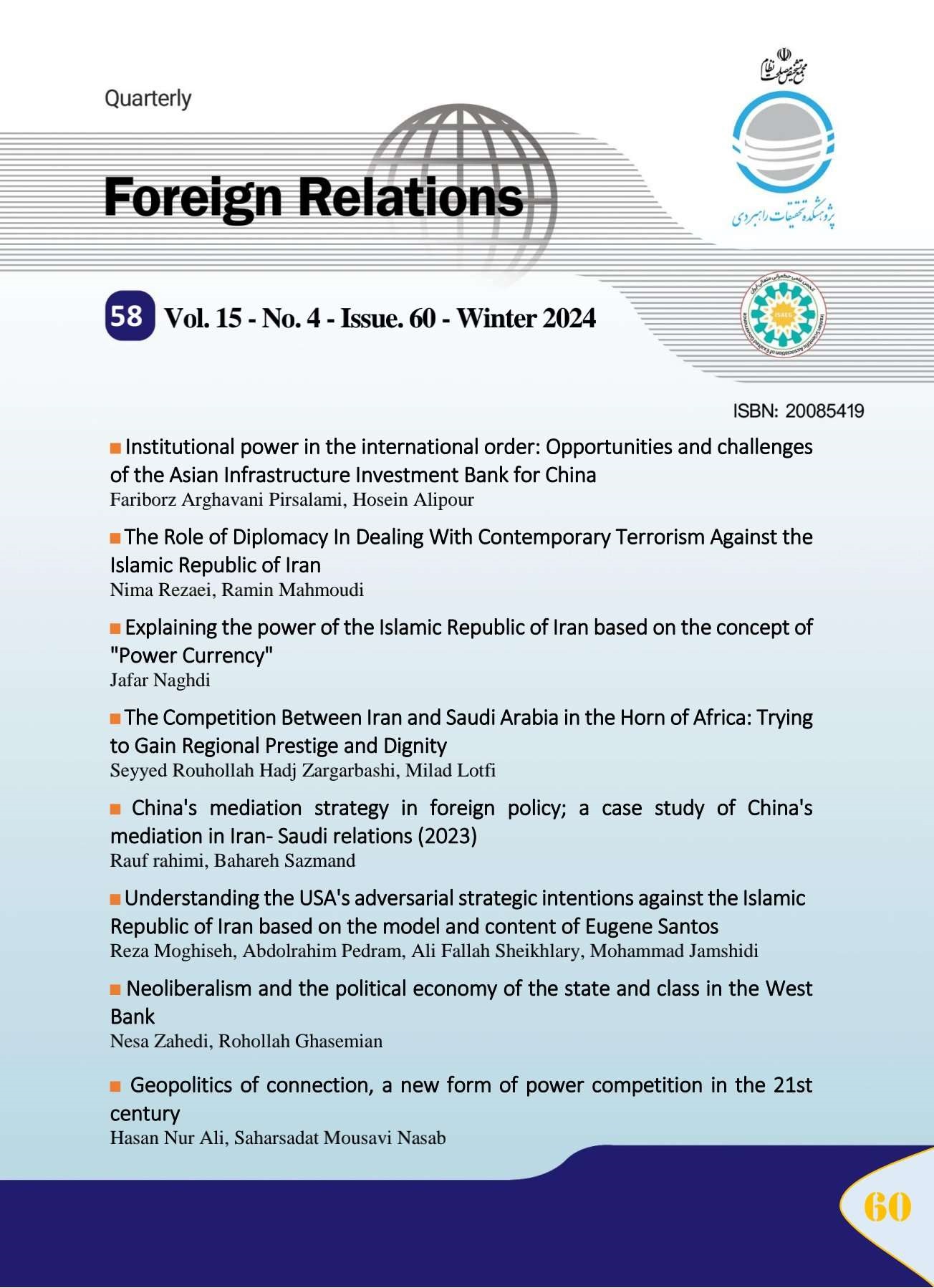
Contemporary or new terrorism is one of the new phenomena that has caused various effects on human life in the 21st century. On the other hand, states are trying to reduce the scope of the negative effects of contemporary terrorism on human life by using defensive and offensive counterterrorist measures. The main goal of this research is to investigate the role of diplomacy in dealing with contemporary or new terrorism against the Islamic Republic of Iran. diplomacy in Islamic Republic of Iran is done by institutions such as the SHOAM(Supreme National Security Council), SHAAK(the National Security Council), VAJA(the Ministry of Intelligence and Security (MOIS)), the Intelligence Organization of the Islamic Revolutionary Guard Corps, VACH(the Ministry of Foreign Affairs), etc... In this regard, the mainstream terrorism studies and the opinions of thinkers such as Wilkinson, Jackson, Kurtulus, Smelser & Mitchell, Hoffman, Rogers, etc. have been chosen as the theoretical framework of the current research in order to be able to answer the main question of research. Therefore, this research seeks to answer the main question, "What is the role of diplomacy in dealing with contemporary terrorism against the people and the state of Iran?" It presents the hypothesis that "by using diplomacy, the Islamic Republic of Iran can carry out 9 basic counterterrorist measures in dealing with contemporary terrorism:
Barston, R. P. (2013). Modern Diplomacy. Fourth Edition. London & New York: Routledge.
Berridge, G. R., & Lloyd, L. (2012). The Palgrave Macmillan Dictionary of Diplomacy. Third Edition. New York & Hampshire: Palgrave Macmillan.
Blakeley, R. (2010). State terrorism in the social sciences: Theories, methods and concepts. In Richard Jackson, Eamon Murphy & Scott Poynting. Contemporary State Terrorism: Theory and practice. London & New York: Routledge.
Breen Smyth, M., Gunning, J., Jackson, R., Kassimeris, G., & Robinson, P. (2008). Critical Terrorism Studies: an introduction. Critical Studies on Terrorism, 1(1), 1-4.
Clark, R. M. (2013). Intelligence Analysis: A Target-centric Approach. Fourth Edition. Washington, DC: SAGE Publications Ltd.
Cole, B. (2006). Introduction. In Benjamin Cole. Conflict, Terrorism and the Media in Asia. London & New York: Routledge.
Dorman, A. M., & Uttley, R. H. (2016). Defense and Intelligence Diplomacy. In Alison R. Holmes & Simon J. Rofe. Global Diplomacy: Theories, Types, and Models. Boulder, Colorado: Westview Presoulder.
Duyvesteyn, I., & Malkki, L. (2012). Is there a ‘new terrorism’ in existence today?- NO: the fallacy of the new terrorism thesis. In Richard Jackson & Daniela Pisoiu. Contemporary Debates on Terrorism. Second Edition. London & New York: Routledge.
Ganor, B. (2012). Are counterterrorism frameworks based on suppression and military force effective in responding to terrorism?- YES: the use of force to combat terrorism. In Richard Jackson & Daniela Pisoiu. Contemporary Debates on Terrorism. Second Edition. London & New York: Routledge.
Godson, R. (1987). Intelligence: An American View. in K. G. Robertson. British and American Approaches to Intelligence. London: Palgrave Macmillan.
Herring, E. (2008). Critical Terrorism Studies: an activist scholar perspective. Critical Studies on Terrorism. 1(2): 197-211.
Hoffman, B. (2006). Inside Terrorism: Revised and Expanded Edition. New York: Columbia University Press.
Jackson, R. (2009). Knowledge, Power and Politics in the Study of Political Terrorism. In Richard Jackson, Marie Breen Smyth & Jeroen Gunning. Critical Terrorism Studies: A new research agenda. London & New York: Routledge.
Kornprobst, M. (2016). Statecraft, Strategy and Diplomacy. In Costas M. Constantinou, Pauline Kerr and Paul Sharp. The SAGE Handbook of Diplomacy. London, Thousand Oaks, New Delhi & Singapore: SAGE.
Kurtulus, E. N. (2012). Is there a ‘new terrorism’ in existence today?- YES: the relevance of the ‘new terrorism’ concept. In Richard Jackson & Daniela Pisoiu. Contemporary Debates on Terrorism. Second Edition. London & New York: Routledge.
Laqueur, W. (2003). No End to War: Terrorism in the Twenty-first Century. New York: Continuum.
Laqueur, W. (1986). Reflections on Terrorism. Foreign Affairs, 65, 86–100.
Lowenthal, M. M. (2009). Intelligence: From Secrets to Policy. Fourth Edition. New York: CQ Press.
Mac Ginty, R. (2012). Is Critical Terrorism Studies a useful approach to the study of terrorism?- NO: don’t give it the oxygen of publicity. In Richard Jackson & Daniela Pisoiu. Contemporary Debates on Terrorism. Second Edition. London & New York: Routledge.
Nacos, B. L. (2002). Mass Mediated Terrorism. Oxford: Rowan and Littlefield.
Pillar, P. R. (2008). Counterterrorism. In Paul D. Williams. Security Studies: an introduction. London & New York: Routledge.
Rogers, P. (2008). Terrorism. In Paul D. Williams. Security Studies: an introduction. London & New York: Routledge.
Schmid, A. P. (2011). Psychological, Political, Economic, Religious and Cultural (Root) Causes of Terrorism, According to Scholars Gathered at the Club de Madrid Conference of 2005. In Alex P. Schmid. The Routledge Handbook of Terrorism Research. London & New York: Routledge.
Seib, P., & Janbek, D. M. (2011). Global Terrorism and New Media: The post-Al Qaeda generation. London & New York: Routledge.
Sheehan, M. A. (2004). Diplomacy. In Audrey Kurth Cronin & James M. Ludes. Attacking Terrorism: Elements of a Grand Strategy. Washington, DC: Georgetown University Press.
Smelser, N. J. & Mitchell, F. (2002). Terrorism: Perspectives from the Behaviorial and Social Sciences. Washington, DC: The National Academies Press.
Wilkinson, P. (2006). Terrorism versus Democracy: The Liberal State Response. Second Edition. London & New York: Routledge.
Rezaei, N., & Mahmoudi, R. (2024). The Role of Diplomacy In Dealing With Contemporary Terrorism Against the Islamic Republic of Iran. International Quarterly of Foreign Relations, 15(4), 35-68. https://doi.org/10.22034/fr.2024.417353.1444
MLA
Rezaei, N., & Mahmoudi, R. "The Role of Diplomacy In Dealing With Contemporary Terrorism Against the Islamic Republic of Iran", International Quarterly of Foreign Relations, 15, 4, 2024, 35-68. doi: 10.22034/fr.2024.417353.1444
HARVARD
Rezaei N., Mahmoudi R. (2024). 'The Role of Diplomacy In Dealing With Contemporary Terrorism Against the Islamic Republic of Iran', International Quarterly of Foreign Relations, 15(4), pp. 35-68. doi: 10.22034/fr.2024.417353.1444
CHICAGO
N. Rezaei & R. Mahmoudi, "The Role of Diplomacy In Dealing With Contemporary Terrorism Against the Islamic Republic of Iran," International Quarterly of Foreign Relations, 15 4 (2024): 35-68, doi: 10.22034/fr.2024.417353.1444
VANCOUVER
Rezaei N., Mahmoudi R. The Role of Diplomacy In Dealing With Contemporary Terrorism Against the Islamic Republic of Iran. Int Q Foreign Relat. 2024;15(4):35-68 (In Persian). doi: 10.22034/fr.2024.417353.1444