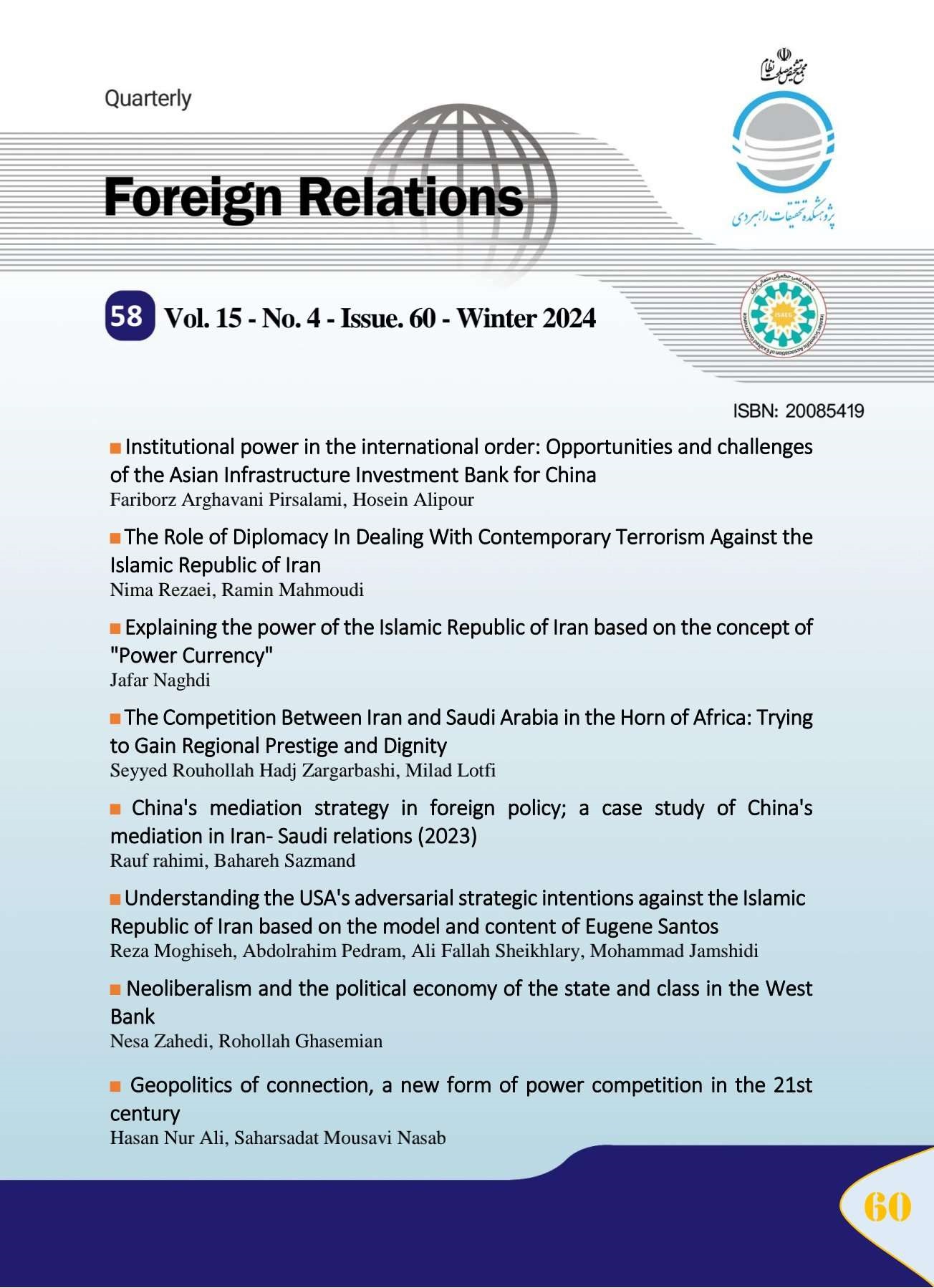
International Quarterly of Foreign Relations

International Quarterly of Foreign Relations

Understanding the USA's adversarial strategic intentions against the Islamic Republic of Iran based on the model and content of Eugene Santos

Document Type : Original Article

Authors
1 PhD in Futures Studies Management, Supreme National Defense University
2 PhD in Futurology and Assistant Professor of the Supreme National Defense University.
3 MA from Iran University of Science and Technology, Excellent expert of Industry
4 PhD in Regional Studies and International Relations and Assistant Professor of the University of Tehran and Deputy for Political Affairs of the President's Office.
Abstract
In all of battles and wars, especially wars of will and determination, early understanding the enemy's intentions, plans and maps is an important factor in victory. Knowing the general plan or understanding the intentions of the enemy requires model and framework; In this article, by descriptive and analytical method and using documentary and library sources, the Sentos model is presented to understand the strategic intentions of the United States against Iran. Almost after Gary Hamel, most of the literature for understanding strategic intentions, especially with adverserial approach, belongs to Eugene Sentos. The components of the Santos intentions model to terms of comprehensiveness and depth are superior than other models in, especially for strategic levels. The components of her model include "Iran's fundamental beliefs and assumptions about itself", "Iran's beliefs about the United States", "Iran's basic goals toward the United States", and "Iran's basic actions toward the United States". His model is more valuable than his findings about Iran. Understanding strategic intentions have shifted from person-centered to intent fusion systems, this systems connect to a variety of behavioral sensors in the air (satellite, aircraft, and UAV), land, sea, and political, Social, economic, industrial and infrastructure networks and this systems with the help of knowledge bases, artificial intelligence and software systems are on the verge of accessing big data, meta-analyzes and social knowledge are more real. The IRI and its institutions must logically and systematically design models and processes for understanding the strategic intentions of the enemies in their structure and contexts.
Keywords

Subjects


  • Ajzen, Icek(2006). Constructing a TPB questionnaire: Conceptual and methodological considerations. Retrieved from people.umass: http://www.people.umass.edu/aizen/pdf/tpb.measurement.pdf
  • Ajzen, Icek, and Fishbein, Martin(1975). Belief, attitude, intention, and behavior: An introduction to theory and research. Reading,MA: Addison-Wesley. Retrieved from Ajzen, Icek, Fishbein, Martin(1975). Belief, attitude, intention, and behavior: An introduction to theory and research. Reading, MA: Addison-Wesley.
  • Benjamin, Bell, Santos, Jr. Eugene, and Brown, M. Scot(2005). Making Adversary Decision Modeling Tractable with Intent Inference and Information Fusion. In Adversarial intent inference for predictive battlespace awareness. AFRL-IF-RS-TR-2005-378, Final Technical Report, November.
  • Brand, Colin George(2010). A Model for the Formulation of Strategic Intent Based on a Comparison of Business and the Military. University of South Africa, November.
  • Brown, M. Scott, Santos, Jr. Eugene, and Benjamin, Bell(2005). Knowledge Acquisition for Adversary Course of Action Prediction Models. AFRL-IF-RS-TR-2005-378, Final Technical Report, November.
  • Hamel, Gary, and Prahalad, C.K(1989, May-June). Strategic Intent. Harvard Business Review, 63-76.
  • Hamel, Gary, and Prahalad, C.K(1994). Competing for the Future,. Harvard Business Review.
  • Kott, Alexander and McEneaney, William M(2006). Adversarial Reasoning: Computational Approaches to Reading the Opponent’s Mind (1st ed.). Chapman and Hall/CRC; 1st edition.
  • Kuznar, Lawrence A, Astorino-Courtois, Allison and Canna, Sarah(2011). From the Mind to the Feet; Assessing the Perception-toIntent-to-Action, Dynami. national Security Innovations (nSI), Air University Press.
  • Lanir, Z(1983). Fundamental surprise: The national intelligence crisis. Tel-Aviv: Hakibutz Hama’ukhad.
  • Maheshwari, R and saurabh, Agarwal(2020). Strategic Management. SBPD Publishing house of Indian.
  • Mburu, S.N and Thuo, J.K(2015, June). Understanding the Concept of Strategic Intent, International Refereed Journal of Engineering and Science. (IRJES), ISSN (Online), 2319-183X, (Print) 2319-1821, Volume 4(Issue 6), 57-60.
  • Owens, Dawn and Khazanchi, Deepak. (2018) From Strategic Intent to Implementation: How Information Technology initiatives take shape in organizations. Proceedings of the 51st, Hawaii International Conference on System Sciences.
  • Richards, C(2004). Sting like a bee, Certain to Win, The Strategy of John Boyd, Applied to Business. Atlanta, GA: Xlibris, 60-66.
  • Romar, J. Edward(2009). Strategic Intent, Confucian Harmony and Firm Success. Confucian Harmony and Firm Success, Acta Polytechnica Hungarica, Vol. 6, 6(3).
  • Roy, Olivier(2008). Thinking before Acting Intentions, Logic, Rational Choice. Thinking before Acting Intentions, Logic, Rational Choice, ILLC-publications, Institute for Logic, Language and Computation, Universiteit van Amsterdam.
  • Santos, ugene Jr(2005). Adversarial intent inference for predictive battlespace awareness. AFRL-IF-RS-TR-2005-378, Final Technical Report. doi:10.21236/ada442035
  • Santos, Eugene Jr and Qunhua, Zhao(2007). Adversarial Models for Opponent Intent Inferencing. In A. Kott and W. McEneaney (Eds.), Adversarial Reasoning: Computational Approaches to Reading the Opponent’s Mind. Boca Raton- London -New York.: Chapman and Hall/CRC(Taylor and Francis Group).
  • Santos, Eugene Jr, McQueary, Bruce and Krause, Lee(2008). Modeling Adversarial Intent for Interactive Simulation and Gaming, The Fused Intent System. Proc. of SPIE, Vol. 6965 696503-2.
  • Tanev, Todor(2012). Efficiency and Effectiveness of Grand Strategy. Public Policy, 3(1).
  • Yarhi-Milo, Keren(2014). Knowing the Adversary: Leaders, Intelligence, and Assessment of Intentions in International Relations. Princeton, New Jersey, United States: Princeton and oxford University Press. Retrieved Jul 21, 2014