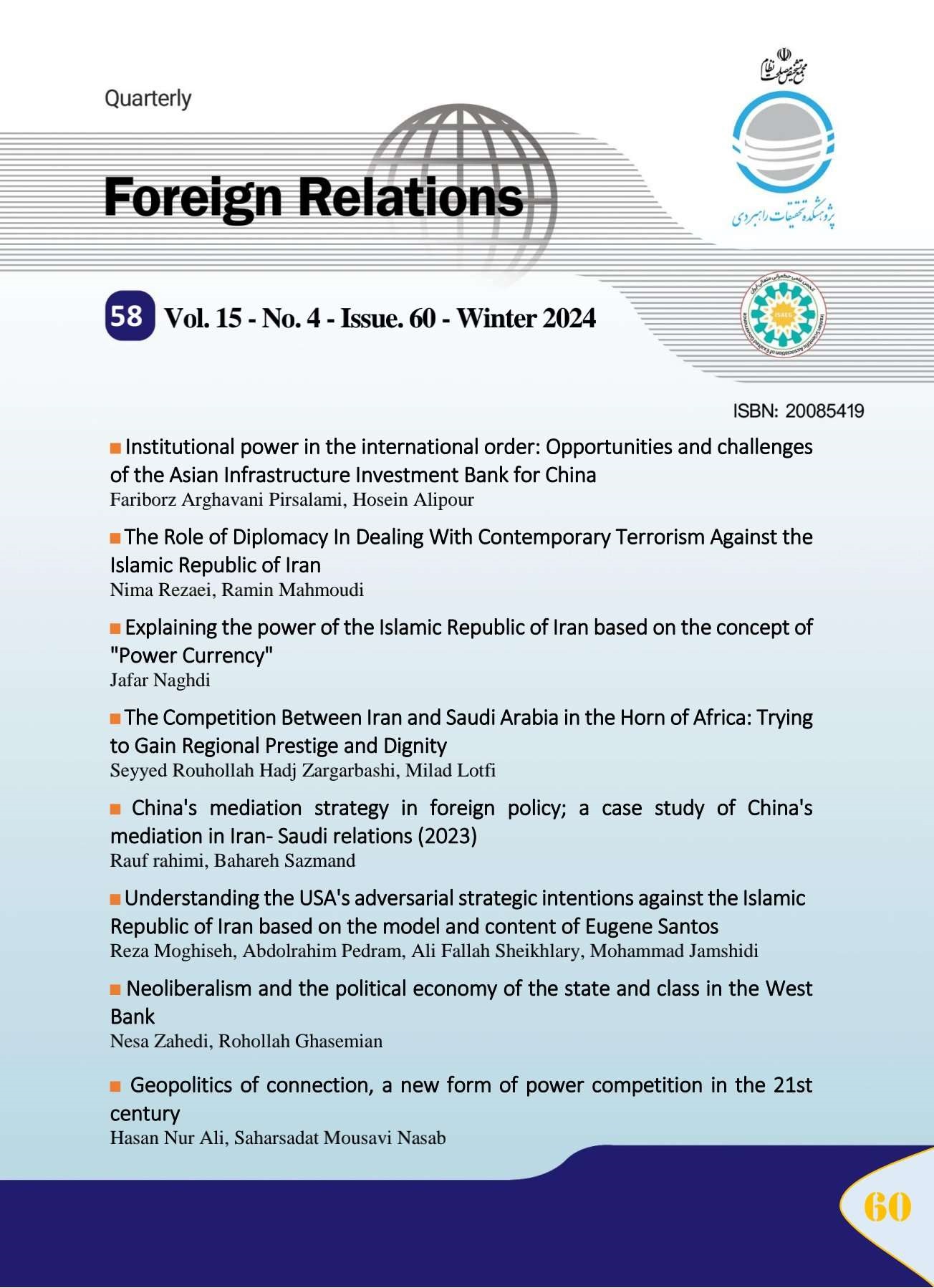
is not possible to understand the nature of structural changes and the transformation of the political economy of the Middle East and North Africa without understanding the current of modernization and neoliberal policies in this region. The evidence is that the output of neoliberal policies in the region is the collapse of models of capital accumulation in an unbalanced way, the formation of The new class and the emergence of capitalism is a greenhouse inside, which has had no result except the expansion of inequalities, ecological crises, exploitation of women, increase in informal work and class gap, rising debt and food crisisThe present article, with descriptive and analytical method, aims to answer the main question that neoliberalism and its goals and indicators in the Middle East have had an effect on the nature of the political economy of the region and the formation of new classes for the benefit of the existing governments. The hypothesis is that the application of neoliberal policies as a strongly government-oriented project will cause the internationalization of capital in favor of authoritarian governments as regular managers of capitalism inside, the formation of emigrant capitalism and global capitalism, structural adjustment.
Zahedi, N., & ghasemian, R. (2024). Neoliberalism and political economy in Middle East. International Quarterly of Foreign Relations, 15(4), 176-200. https://doi.org/10.22034/fr.2024.396848.1381
MLA
Zahedi, N., & ghasemian, R. "Neoliberalism and political economy in Middle East", International Quarterly of Foreign Relations, 15, 4, 2024, 176-200. doi: 10.22034/fr.2024.396848.1381
HARVARD
Zahedi N., ghasemian R. (2024). 'Neoliberalism and political economy in Middle East', International Quarterly of Foreign Relations, 15(4), pp. 176-200. doi: 10.22034/fr.2024.396848.1381
CHICAGO
N. Zahedi & R. ghasemian, "Neoliberalism and political economy in Middle East," International Quarterly of Foreign Relations, 15 4 (2024): 176-200, doi: 10.22034/fr.2024.396848.1381
VANCOUVER
Zahedi N., ghasemian R. Neoliberalism and political economy in Middle East. Int Q Foreign Relat. 2024;15(4):176-200 (In Persian). doi: 10.22034/fr.2024.396848.1381