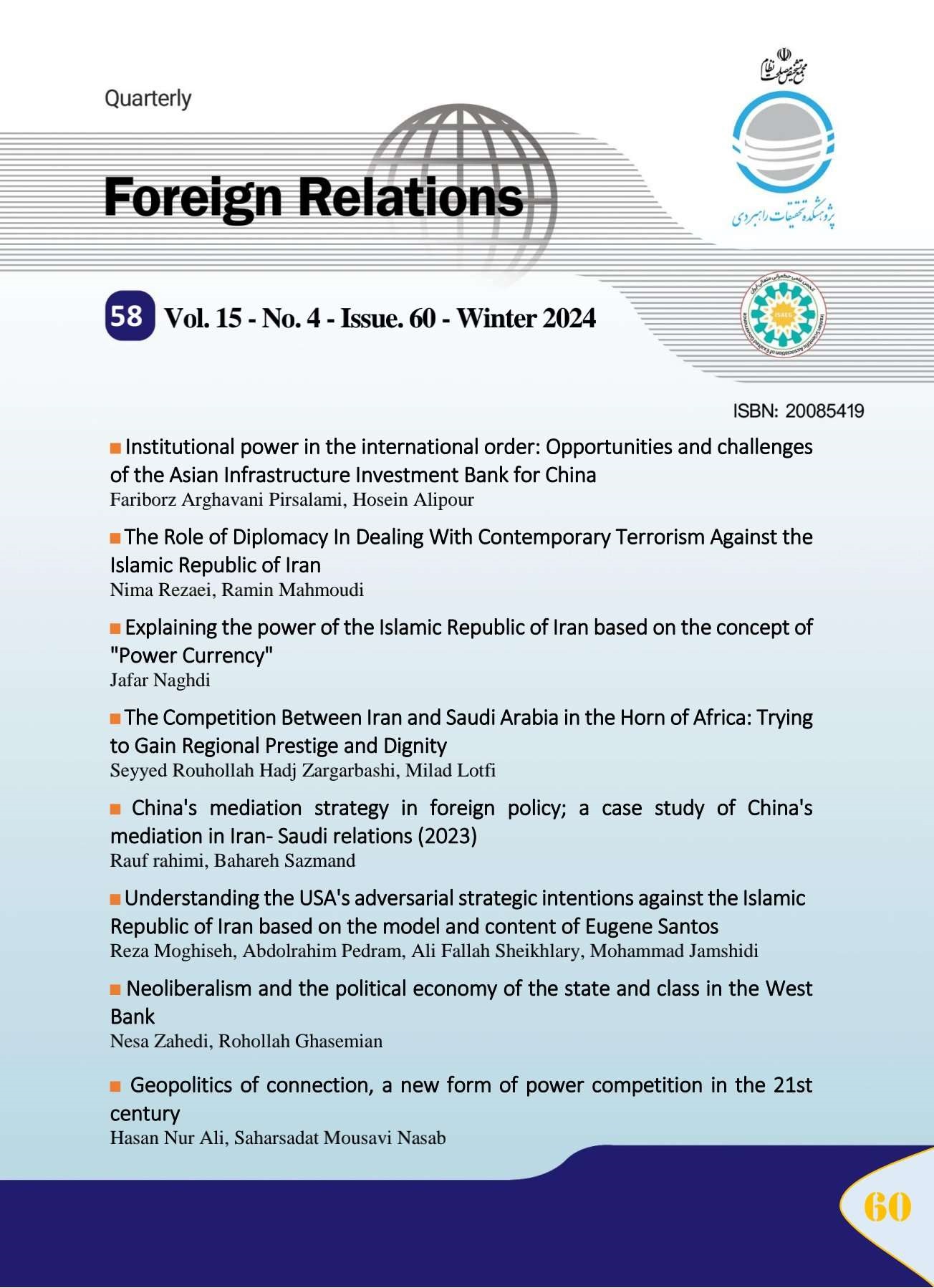
The concept of the geopolitical code was originally expressed by Gaddis (1982) in his analysis of post-war security policy in the United States. However, Taylor and Flint have been the main contributors to the development and strengthening of this idea in the geopolitical literature. Geopolitical code is defined as the operating code of a government’s foreign policy that evaluates places beyond its boundaries. ‘It is a set of strategic assumptions that a government makes about other states in forming its foreign policy. The geography of transportation is to study the geographical areas in which transportation is done and includes water-based and land-based strips as the main routes; furthermore, ports are the connection between these two geographical areas. Ports, as geoeconomic components, because they are at the heart of global trade, are clearly an issue in the geography of transportation. In such a way these effective components play an important role in the geography of transportation, in important and key crossings, shipping control points, and global corridors. In the twentieth century, the key role of geographical spaces in the competition of world powers had attracted the attention of geopolitical thinkers to transportation technology.
Allen, J. (2003). Lost Geographies of Power. Malden, MA and Oxford, Blackwell.
Arrighi, G., (1990). "The Three Hegemonies of Capitalism" Review 13(3), 365-408.
Ashraf, J., (2017). String of Pearls and China's Emerging Strategic Culture. Strategic Studies, 37 (4), 166-181.
Bennett, M., (2016). The Silk Road goes north, Russia’s role within China’s Belt and Road Initiative, Area Development and Policy, 1(3), 341-351, DOI, 10.1080/23792949.2016.1239508.
Carmody, P. and Taylor, I. (2010). Flexigemony and Force in China's Resource Diplomacy in Africa, Sudan and Zambia Compared, Geopolitics, 15 (3), 496-515.
Choong, W. (2019). The return of the Indo-Pacific strategy, an assessment, Australian Journal of International Affairs, (73) 5, 415-430. https,//doi.org/10.1080/10357718.2019.1639134
Di Marco, E., (2019). Return to Heartland - The New Silk Road and its impact on the transformations of global governance, Dissertation in Political Geography for the Bachelor's degree in Political Science and International Relations, Università di Napoli “L'Orientale, DOI,10.13140/RG.2.2.20751.94882.
Dragneva, R., and Hartwell, C.A., (2021). The Eurasian Economic Union, integration without liberalisation?, Post-Communist Economies, 33 (2-3), 200-221. https,//doi.org/10.1080/14631377.2020.1793586
Europe and Central Asia Report N°240, (2016). The Eurasian Economic Union, Power, Politics and Trade, International Crisis Group, Headquarters.
Flint, C. and Noorali, H. (2023). The Relationality of Geopolitical Codes, The Example of the Belt and Road initiative, Asian Geographer, 2023.
Flint, C. (2022). Introduction to Geopolitics, London and New York, Routledge.
Flint, C. & Taylor, P. J., (2018). Political Geography,World-Economy, Nation-State and Locality. London and New York, Routledge.
Flint, C., and Zhou, C., (2018). The geopolitics of connectivity, cooperation, and hegemonic competition, The Belt and Road Initiative. Geoforum. 99, 95-101. https,//doi.org/10.1016/j.geoforum.2018.12.008
Flint, C. and Zhang, X., (2019). “Defining Geopolitical Context, China’s Dynamic Foreign Policy within Global Economic and Hegemonic Cycles.” Chinese Journal of International Politics 12 (3), 295-331. https,//doi.org/10.1093/cjip/poz011.
Haiquan, L., (2017). The Security Challenges of the “One Belt, One Road” Initiative and China’s Choices. Croatian International Relations Review 23(78), 129-147. DOI, 10.1515/cirr-2017-0010
Harvey, D. (1982) The Limits to Capital, Oxford, Blackwell.
Harvey, P. & Jensen, C. & Morita, A., (2016). Infrastructure and Social Complexity, A Companion, London and New York, Routledge.
Harvey, P. (2017). Casper Jensen and Morita Atsuro. Infrastructure and Social Complexity, A Companion, London, Routledge.
He, A. (2020). ‘The Belt and Road Initiative, Motivations, financing, expansion and challenges of Xi’s ever-expanding strategy.’, Journal of Infrastructure, Policy and Development, 4)1), 139-169.
Högselius, P. (2022). The hidden integration of Central Asia, the making of a region through technical infrastructures, Central Asian Survey 41 (2), 223-243. Technology, Temporality and the Study of Central Asia. https,//doi.org/10.1080/02634937.2021.1953963
Ito, A. (2019). China’s Belt and Road Initiative and Japan’s Response, from Non-participation to Conditional Engagement, East Asia, 36, 115-128.
Jash, A., (2019). China’s Japan Challenge, Regional Ambitions and Geopolitics of East Asia, in Book, EAST ASIA STRATEGIC REVIEW, China’s Rising Strategic Ambitions in Asia, New Delhi, Institute for Defence Studies and Analyses.
R. D., (2018). The Return of Marco Polo's World, War, Strategy, and American Interests in the Twenty-first Century, New York, Random House.
Kazantsef, A., Medvedeva, S, and Safranchuk, S., (2021). Between Russia and China, Central Asia in Greater Eurasia, Journal of Eurasian Studies, 12 (1). https,//doi.org/10.1177/1879366521998242
Keser, H., (2015). Importance of Transport Corridors in Regional Development, The Case of TRACECA. Sosyoekonomi 24 (24), 163-182.
G., (2018). Maritime Perspectives 2018. New Delhi, National Maritime Foundation.
Kuteleva, A. & Vasilev, D., (2020). “China’s Belt and Road Initiative in Russian Media, Politics of Narratives, Images, and Metaphors”, Journal of Eurasian Geography and Economics, 1-25. https,//doi.org/10.1080/15387216.2020.1833228
Lin, W., (2019). Transport geography and geopolitics, Visions, rules and militarism in China's Belt and Road Initiative and beyond. Journal of Transport Geography. Elsevier, 81(C). DOI, 10.1016/j.jtrangeo.2019.05.001.
Lukin, A. (2019). Russian–Chinese Cooperation in Central Asia and the Idea of Greater Eurasia, Indian Council of World Affairs (ICWA), DOI, 10.1177/0974928418821477
Marshall Jr, R., (2012). The String of Pearls, Chinese maritime presence in the Indian ocean and its effect on Indian naval doctrine. Monterey, California, Naval Postgraduate School.
Mayer, M. and Zhang, X. 2020. "Theorizing China-world integration, sociospatial reconfigurations and the modern silk roads. Review of International Political Economy 28 (4), 974-1003.
Medcalf, R., (2020). Indo-pacific Empire, China, America, and the Contest for the World's Pivotal region. Manchester, University of Manchester Press.
Minghao, Z., (2016). The Belt and Road initiative and its implications for China-Europe relations, the International Spectator, 51 (4), 1-10. https,//doi.org/10.1080/03932729.2016.1235819
Mitchell, D. (2021). Making or Breaking Regions, China’s Belt Road Initiative and the Meaning for Regional Dynamics. Geopolitics, 26 (5), 1400-1420. https,//doi.org/10.1080/14650045.2020.1716738
Mohan, C., (2012). Samudra Manthan Sino-Indian Rivalry in the Indo-Pacific. Washington, D.C., Carnegie Endowment for Int'l Peace.
Moisio, S., (2021). "Re-thinking geoeconomics, Towards a political geography of economic geographies. Geography Compass 13(10). DOI, 10.1111/gec3.12466
Murashkin, N. (2018). Not-so-new Silk Roads, Japan’s foreign policies on Asian connectivity infrastructure under the radar. Australian Journal of International Affairs, 72(5), 455-472. doi,10.1080/10357718.2018.1510896
Narins, T., and Agnew, J., (2020). Missing from the Map, Chinese Exceptionalism, Sovereignty Regimes and the Belt Road Initiative, Geopolitics, 25 (4), 809-837. https,//doi.org/10.1080/14650045.2019.1601082
Narins, T., and Agnew, J., (2022). Veiled futures? Debt burdens, the Belt Road Initiative, and official Chinese lending after coronavirus, Human Geography 15(2),190-205.
(2019). Indo-Pacific Report 2019, Indo-PacIfIc PaRtneRshIP, Realising the Benefits of Economic and Maritime Cooperation. New Delhi, National Maritime Foundation.
Noorali, H. & Campana, M. (2022). Geopolitics of Access, Analyzing the role of warm water ports in the 2014 crisis and the 2022 war between Russia and Ukraine. International Conference ‘Geopolitical Challenges of the Russo-Ukrainian War, from the Black Sea to the Arctic Ocean’ November 3rd – 5th, 2022. Bucharest, Romania.
Office of the Secretary of Defense, (2020). Military and Security Developments Involving the People’s Republic of China, 2020, Annual Report to Congress. Washington, DC. Ii.
Pop, I. I., (2016). Strengths and Challenges of China’s One Belt One Road Initiative, Centre for Geopolitics & Security in Realism Studies. February 09, 2016, http,//cgsrs.org/publications/46 Accessed April 8, 2021
Project Mausam, (2020). Mausam, Maritime Routes and Cultural Landscapes. Ministry of culture, government of india. https,//www.indiaculture.nic.in/project-mausam Accessed 29, November 2021.
Rahul, A., (2018). The Game for Regional Hegemony, China's OBOR and India's Strategic Response, Brazilian Journal of Strategy & International Relations e- 7 (13), 159-196.
Rustemova, A. (2011). Political economy of Central Asia, Initial reflections on the need for a new approach, Journal of Eurasian Studies, 2 (1), 3-49. https,//doi.org/10.1016/j.euras.2010.10.002
Sarkar, M. G. (2020). "China and QUAD 2.0, Between response and regional construct." Maritime Affairs, Journal of the National Maritime Foundation of India, 16,1, 110-130, (Maritime Affairs, Journal of the National Maritime Foundation of India). https,//doi.org/10.1080/09733159.2020.1794526
Sarker, M., Hossin, M., Yin, X. & Sarkar, M., (2018). One Belt One Road Initiative of China, Implication for Future of Global Development. Modern Economy, 9 (4), 623-638. DOI, 10.4236/me.2018.94040
Schindler, S., Dicarlo, J., & Paudel, D. (2021). "The new cold war and the rise of the 2 1st century infrastructure state., Transcations Institute of British Geographers, RGS, 18 June 2021, DOI, 10.1111/tran.12480 https,//rgs-ibg.onlinelibrary.wiley.com/doi/full/10.1111/tran.12480
Sergi, B.S., (2018). Putin's and Russian-led Eurasian Economic Union, A hybrid half-economics and half-political “Janus Bifrons”, Journal of Eurasian Studies, 9 (1), 52-60. https,//doi.org/10.1016/j.euras.2017.12.005
Singh, K. D. P. (2019). Strength and Challenges of OBOR Initiative, Indian Perspective, Journal of National Law University Delhi 6(1) 65–77. https,//doi.org/10.1177/2277401719857865
Singh, S. and Singh, B. (2019). Geopolitics of ports, Factoring Iran in India’s counterbalancing strategy for “Sino-Pak Axis”. Journal of Eurasian Studies, 10 (2), 169–182. https,//doi.org/10.1177/1879366519850712
Sternberg, T., Ahearn, A. & McConnell, F., (2017). Cental Asia’s Characteristics on Chinas New Silk Road, the Role of Landscape and the Politics of Infrastructure, Land 6 (55), 2-16.
Sum, N-L., (2019). The intertwined geopolitics and geoeconomics of hopes/fears, China’s triple economic bubbles and the ‘One Belt One Road’ imaginary, Territory, Politics, Governance, 7 (4), 528-552.
Summers, T., (2020). Negotiating the boundaries of China's Belt and Road Initiative, Environment and Planning C, Politics and Space, 38 (5), DOI, 10.1177/2399654420911410.
Sun, D., and Zoubir, Y. 2017. “Development First”, China’s Investment in Seaport Constructions and Operations along the Maritime Silk Road. Asian Journal of Middle Eastern and Islamic Studies, 11 (3), 35-47. https,//doi.org/10.1080/25765949.2017.12023308
Toje, A., 2018. Will China’s Rise Be Peaceful?, The Rise of a Great Power in Theory, History, Politics, and the Future. Oxford, Oxford University Press.
Yeghiazaryan, M. (2021). "The Geopolitical Aspirations of the "One Belt, One Road Initiative", April 2021, University of Florence School of Political Science “Cesare Alfieri” International Relations and European Study Course.
Zakaria, Z., (2008), “The Rise of a Fierce Yet Fragile Superpower,” Newsweek (December 31, 2007–January 7, 2008), 6.
Zhao, J., Sun, G., and Webster, C. 2022. Does China-Pakistan Economic Corridor improve connectivity in Pakistan? A protocol assessing the planned transport network infrastructure, Journal of Transport Geography, 100. https,//doi.org/10.1016/j.jtrangeo.2022.103327
Zhao, H., (2019). Chapter Nine - Maritime Transportation Security, “Malacca Dilemma” and “Strings of Pearls”, The Economics and Politics of China's Energy Security Transition, 199-218. https,//doi.org/10.1016/B978-0-12-815152-5.00009-92018
Zhang, C, Zhang, M. and Xiao, C. (2022). From traditional infrastructure to new infrastructure, a new focus of China’s Belt and Road Initiative diplomacy? Eurasian Geography and Economics 63 (3), 424-443. https,//doi.org/10.1080/15387216.2022.2039740
Zhexin, Z., (2018). The Belt and Road Initiative China’s New Geopolitical Strategy? Publishing Corporation and Shanghai Institutes for International Studies China Quarterly of International Strategic Studies, 4 (3), 327–343.
Noorali, H., & Mousavi Nasab Rabori, S. S. (2024). The Geopolitics of Connectivity: A New Form of Power Competition in the 21st Century. International Quarterly of Foreign Relations, 15(4), 201-238. https://doi.org/10.22034/fr.2024.382244.1342
MLA
Noorali, H., & Mousavi Nasab Rabori, S. S. "The Geopolitics of Connectivity: A New Form of Power Competition in the 21st Century", International Quarterly of Foreign Relations, 15, 4, 2024, 201-238. doi: 10.22034/fr.2024.382244.1342
HARVARD
Noorali H., Mousavi Nasab Rabori S. S. (2024). 'The Geopolitics of Connectivity: A New Form of Power Competition in the 21st Century', International Quarterly of Foreign Relations, 15(4), pp. 201-238. doi: 10.22034/fr.2024.382244.1342
CHICAGO
H. Noorali & S. S. Mousavi Nasab Rabori, "The Geopolitics of Connectivity: A New Form of Power Competition in the 21st Century," International Quarterly of Foreign Relations, 15 4 (2024): 201-238, doi: 10.22034/fr.2024.382244.1342
VANCOUVER
Noorali H., Mousavi Nasab Rabori S. S. The Geopolitics of Connectivity: A New Form of Power Competition in the 21st Century. Int Q Foreign Relat. 2024;15(4):201-238 (In Persian). doi: 10.22034/fr.2024.382244.1342