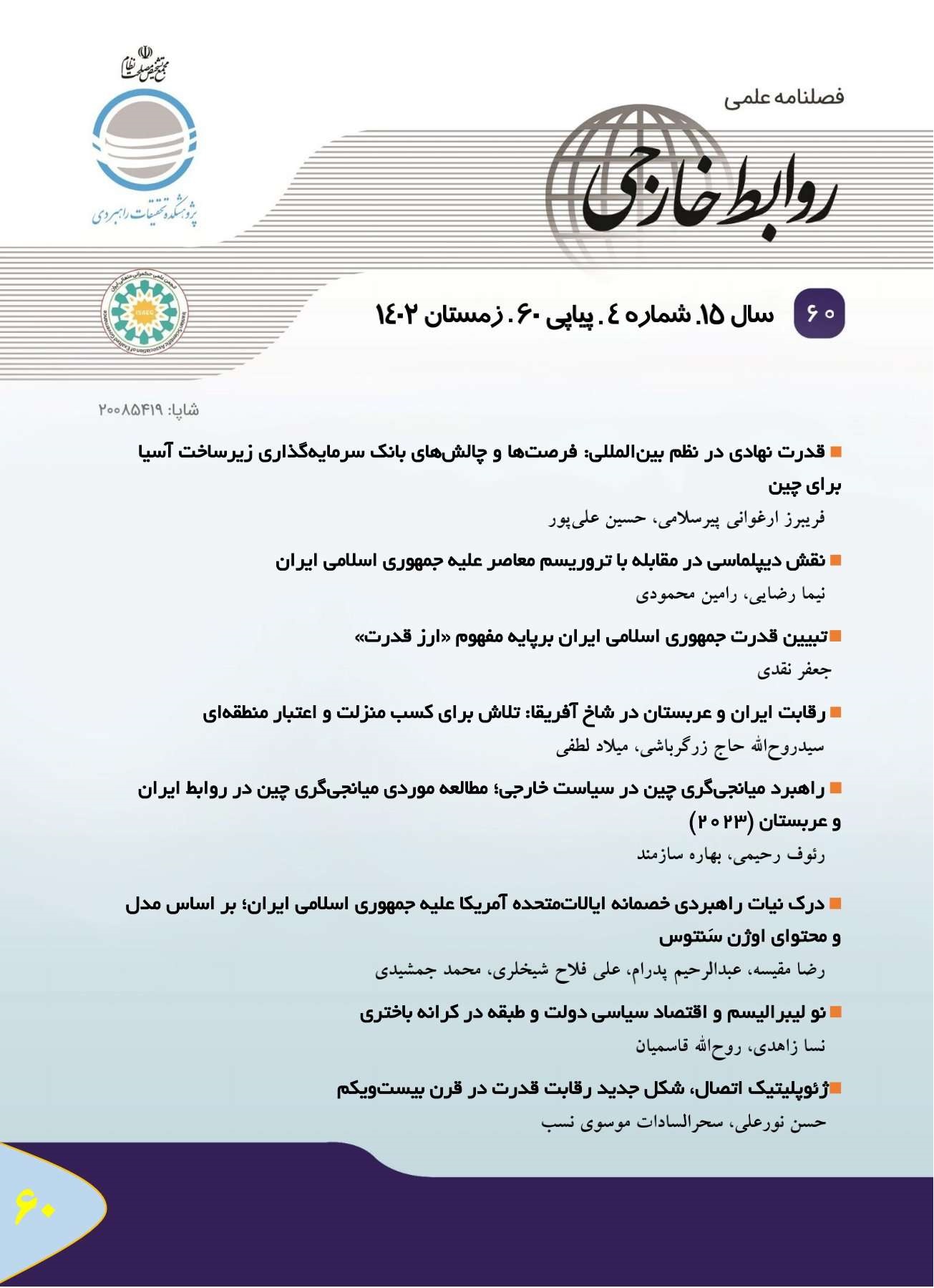
فصلنامه روابط خارجی

فصلنامه روابط خارجی

تحلیل میانجیگری چین در روابط ایران و عربستان در سال 2023

نوع مقاله : مقاله پژوهشی

نویسندگان
1 استادیار گروه علوم سیاسی، دانشگاه بجنورد، خراسان شمالی، ایران
2 دانشیار گروه مطالعات منطقه ای، دانشگاه تهران، تهران، ایران
چکیده
نقش چین به‌عنوان میانجیگر بین عربستان و ایران برای بسیاری از ناظران غافلگیرکننده بود؛ زیرا تا همین اواخر، پکن از دخالت در رویدادهای برجسته درصحنه جهانی اجتناب می‌کرد. چین ترجیح می‌داد تا مسئولیت کنترل تهدیدات علیه ثبات را بر عهده نگیرد و به سازمان ملل نقش ناظر در حوادث جهانی بدهد. میانجیگری چین شاهد جدید و واضحی بود که نشان می‌دهد، پکن از اصل دیپلماسی دنگ شیائوپینگ مبنی بر «در پس‌زمینه ماندن» به دیپلماسی فعال‌تر یک قدرت بزرگ روی آورده است. هدف پژوهش حاضر بررسی نقش چین در میانجیگری بین ایران و عربستان بر اساس نظریه تصمیم‌گیری مرتبط با مدیریت ریسک سایمون است. بر این اساس سؤال پژوهش حاضر این است که چرا ایران و عربستان چین را به‌عنوان میانجی مورد اعتماد و مؤثر انتخاب کردند؟ در پاسخ این فرضیه مطرح می‌شود که مزیت چین برای ایران و عربستان در پارادایم دیپلماتیک آن‌که شامل اجتناب از جانب‌داری؛ تلاش برای نزدیک کردن هر دو طرف به یکدیگر؛ توانایی استفاده از نفوذ فزاینده ژئواکونومیکی چین و خودداری این کشور در استفاده از زور در امور منطقه، نهفته است. هدف این رویکرد ارائه روش جدید برای مشارکت چین در امور صلح منطقه است. نتایج تحقیق حاکی از آن است که موفقیت میانجیگری چین را می‌توان به رویکرد دیپلماتیک پکن در عدم تعهد و عدم‌مداخله نسبت داد که بر تصویر بی‌طرف چین در میان ایران و عربستان و انباشت طولانی‌مدت پیوندهای اقتصادی آن بنا شده است. این رویکرد چین به‌عنوان «توانایی عدم استفاده از قدرت» در نظر گرفته‌شده است. روش پژوهش، کیفی و روش جمع‌آوری داده‌ها کتابخانه‌ای و اسنادی است.
کلیدواژه‌ها

موضوعات


عنوان مقاله English

Analysis of China's mediation in Iran-Saudi relations in 2023

نویسندگان English

Rauf rahimi 1
Bahareh Sazmand 2
1 Assistant Professor, Department of political scinces, Faculty of humanities, University of Bojnord, North Khorasan, Iran
2 Associate Professor, Department of Regional studies, Faculty of Law and Political Science, University of Tehran, Tehran, Iran
چکیده English

China's role as a mediator between Saudi Arabia and Iran was surprising to many observers, because until recently, Beijing avoided from interference in prominent events on the world stage. China would prefer not to assume the responsibility of controlling threats to stability and give the UN an observer role in global events. Chinese mediation was new and clear evidence that Beijing has turned from Deng Xiaoping's principle of staying in the background diplomacy to the more active diplomacy of a great power. The aim of the current research is to investigate the role of China in mediating between Iran and Saudi Arabia based on Simon's decision-making theory related to risk management. Therefore, the basis of the questions of the current research is that why did Iran and Saudi Arabia choose China as a trusted and effective mediator? In response, this hypothesis is proposed that China's advantage for Iran and Saudi Arabia lies in its diplomatic paradigm, which includes avoiding taking one side and trying to bring both sides closer to each other, ability to take advantage of China's growing geo-economic influence and this country refrains from using force in regional affairs. The aim of this approach is to provide a new method for China's participation in regional peace affairs.The results of the research indicate that the success of China's mediation can be attributed to Beijing's diplomatic approach of non-commitment and non-intervention, which is based on China's neutral image between Iran and Saudi Arabia and its long-term accumulation of economic ties.

کلیدواژه‌ها English

Mediation
Agreement
Risk management strategy
Persian Gulf region
National interests

doi:  10.22034/FR.2023.382591.1345                                                                      


References
  • Alterman, Jon B, (2013) “China’s Balancing Act in the Gulf”, Washington, DC, Center for Strategic and International Studies, https://csis-prod.s3.amazonaws.com/s3fs-public/
  • Alzaroon,Najla(2023) “The application of the global security initiative:China’s mediation diplomacy in the gulf”, https://www.researchgate.net/profile/Chaoting_Cheng/publicatio
  • Alijoyo, Antonius,(2021)"A Risk Management and Decision,Making Theory," https://crmsindonesia.org/publications/risk-
  • Anna, Brown(2023)”What Does the Saudi-Iran Deal Mean for the Middle East?” The Washington Institute for Near East,https://www.washingtoninstitute.org/policy-analysis/
  • Aljazeera(2023/3/10)“Iran, Saudi Arabia agree to resume ties: World reacts”, https://www.aljazeera.com/news/
  • Atlantic Council experts (2023)”Experts react: Iran and Saudi Arabia just agreed to restore relations, with help from China. Here’s what that means for the Middle East and the world”, https://www.atlanticcouncil.org/blogs/new-
  • Brown K (2015) “The security implications of China’s Belt and Road. The Diplomat”, https://the diplomat.com/ https://thediplomat.com/2015/11/the-security-
  • BBC, (2017) ‘Syria War: Russia and China Veto Sanctions’, http://www.bbc.com/ news/world-middle-east-39116854
  • Brown CK (2018) China’s dream: the culture of Chinese Communism and the secret sources of its power. Polity Press, Cambridge,https://www.amazon.com/Chinas-Dream-Culture-Chinese-Communism/dp/1509524568
  • Ciorciari,John and Haacke,Jürgen(2019) Hedging in international relations: an introduction, https://academic.oup.com/irap/article-abstract/19/3/367/5563899
  • Cafiero, Giorgio(2023)'Filling the peacemaker vacuum': How China brokered the Saudi-Iran deal, https://www.newarab.com/analysis/how-china-emerged-
  • Campitelli, Guillermo; Gobet, Fernand (2010)"Herbert Simon's Decision-Making Approach: Investigation of Cognitive Processes in experts", Review of General Psychology. 14 (4): doi:1037/a0021256. https://journals.sagepub.com/doi/10.1037/a0021256
  • Christopher, Mitchell(1988) ‘The Motives for Mediation’, New Approaches to International Mediation, New York, Greenwood Press, https://www.bloomsbury.com/us/new-approaches-to-international- /
  • Chéné,Hugo(2017) “China in Afghanistan Balancing Power Projection and Minimal Intervention”, Institute of Peace and Conflict Studies, IPCS Special Report 179,http://www.ipcs.org/ pdf_
  • Chaziza, Mordechai(2013) “China’s Policy on the Middle East Peace Process after the Cold War”, China Report, 49(1), https://journals.sagepub.com/doi/10.1177/0009445513479460
  • Ciborek, Przemysław(2023)”China’s global initiatives:challenges and prospects”
  • New Chinese Initiatives for a Changing Global Security, https://www.researchgate.net/profile/Chaoting_Cheng/publicatio
  • CRI, (2017) ‘China to Help Afghanistan Develop through Commercial Co-ops’, http:// english.cri.cn/12394/
  • Chaziza Mordechai, (2018)”China’s Approach to Mediation in the Middle East: Between Conflict Resolution and Conflict Management” https://www.mei.edu/https://www.mei.edu/publications/chinas-
  • Democracy Now (2023/3/13)”China’s Middle East Deal: Iran & Saudi Arabia Reestablish Relations as U.S. Watches from Sidelines” https://www.democracynow.org/2023/3/13/iran_saudi_arabia
  • Evron, Yoram(2017) “China’s Diplomatic Initiatives in the Middle East: The Quest for a Great-Power Role in the Region”, International Relations, 31(2), https://journals.sagepub.com/doi/abs/10.1177/0047117815619664
  • Evron,Yoram (2017) “China Has a New Middle East Peace Plan”,https://thediplomat.com/2017/08/china-
  • Gallagher; Adam,  Hamasaeed Sarhang and Nada, Garrett (2023)”What You Need to Know About China’s Saudi-Iran Deal” https://www.usip.org/publications/2023/03/what-you
  • -Garver, John W )2011)”Is China Playing a Dual Game in Iran?”https://csis-website-prod.s3.amazonaws.com/s3fs-public/legacy_files/
  • Garlick J, Havlová R (2021)“The dragon dithers: assessing the cautious implementation of China’s belt and road initiative in Iran”,Eurasian Geogr Econ 62(4),/ https://link.springer.com/article/10.1007/s41111-016-0010
  • Gerstl A (2022) “Hedging strategies in Southeast Asia: ASEAN, Malaysia, the Philippines, and Malaysia and their Relations with China”, Routledge, Abingdon,https://www.routledge.com/Hedging-Strategies-in-Southeast-
  • Gulliver, Philip H., (1979)”Disputes and Negotiations: Cross-Cultural Perspectives”, New York, Academic Press,
  • House, Karen Elliott (2023)”Behind China’s Mideastern Diplomacy”, https://www.wsj.com/articles/behind-chinas-mideastern-
  • Haghirian Mehran, and  Scita, Jacopo, (2023)”The Broader Context Behind China’s Mediation Between Iran and Saudi Arabia,” https://thediplomat.com/2023/03/the-broader-context-behind-
  • Hille, Kathrin (2023)”China casts itself as Middle East peacemaker with global ambition” https://www.ft.com/content/9d832121-022b-
  • Hayes A (2022) “Short selling: what is shorting stocks with pros, cons, and examples,” Investopedia. https://www.investopedia.com/terms/s/shortselling.asp
  • Irish, John(2016) ‘China Rules Out Joining Anti-Terrorism Coalitions, Says Helping Iraq’, Reuters, http://www.reuters.com/article/us-mideast-crisis-china-
  • Jin, Wang(2015) “The US Withdrawal and One Belt One Road: Chinese Concerns and Challenges in Afghanistan”, Strategic Assessment, 19(3),https://www.inss.org.il/publication/the-us-withdrawal-a
  • Janardhan,N(2015)”China’s middle east conundrum and prospects for collective security” https://pure.diis.dk/ws/files/650303/
  • Jash,AmritaDate (2023) “Saudi-Iran Deal: A Test Case of China’s Role as an International Mediator”https://gjia.georgetown.edu/ https://gjia.georgetown.edu/2023/06/23/saudi-iran-
  • Khatib, Dania Koleilat (2019) US sanctions bringing China and Iran together”, Arab News,https://www.arabnews.com/node/1553431./amp
  • Keinon, Herb(2017) “China Pushing its Four-Point Peace Plan’, Jerusalem Post,” http://www.jpost.com/Arab-Israeli-Conflict/China-
  • Lanteigne, Marc(2015)”China’s diplomacy in the gulf region:energy and security”,https://www.google.com/search?q=CHINA%E2%80%99S
  • Mitic, Aleksandar (2023)”The strategic communication of china’s global security initiative” New Chinese Initiatives for a Changing Global Security, https://www.researchgate.net/profile/Chaoting_Cheng/publicatio
  • MacGillivray I (2019)“Maturing Sino-Saudi strategic relations and changing dynamics in the Gulf”Global Change”, Peace Secure 31(1), https://www.tandfonline.com/doi/full/10.1080/14781158.2018.1475350
  • Mansour,Imad (2015) “Can china be a pillar of GCC security?” https://www.academia.edu/28959974/Can_
  • Natasha,Turak (2003)”The China-brokered Saudi-Iran deal has big repercussions for the Middle East and the U.S”,https://www.cnbc.com/2023/03/15/does-chinas-role-
  • Parsi,Trita (2023)”How China Became a Peacemaker in the Middle East”, https://quincyinst.org/2023/03/15/how-china-
  • Roy, D (2005)“Southeast Asia and China: balancing or bandwagoning?”Contemp Southeast Asia 27(2),https://www.jstor.org/stable/25798738
  • Roehrich, J. K., Grosvold, J., & Hoejmose, S. U. (2014). Reputational Risks and Sustainable Supply Chain Management. International Journal of Operations and Product Management, 34(5) https://doi.org/10.1108/IJOPM-10-2012-0449
  • Salesio, Schiavi Francesco(2023)” Is China’s Iran-Saudi Deal a Step Towards Peace in the Middle East?”https://www.ispionline.it/ https://www.ispionline.it/en/publication/is-chinas-iran-saudi-deal-
  • Simon, H. A. (1955)”A behavioral model of rational choice. Quarterly Journal of Economics”, https://www.jstor.org/stable/1884852
  • Simon, H. A. (1956)”Rational choice and the structure of the environment,” Psychological Review, https://pages.ucsd.edu/~mckenzie/Simon1956PsychReview.pdf
  • Saab,Bilal. (2023)”Why the Saudi-Iran deal changes little in regional security” https://www.arabnews.com/node/2270596
  • Scobell, Andrew and Nader, Alireza (2016)”China in the Middle East: The Wary Dragon, RAND Corporation, Santa Monica, CA, https://www.rand.org/pubs/research_reports/RR1229.html
  • Sobelman, Daniel (2023)”Saudi-Iranian Agreement is a Positive Development, but Not a Game-changer” https://gulfif.org/the-iran-saudi-agreement-is-not-a-game-changer
  • Schrand C, Unal H (1998)“Hedging and coordinated risk management: evidence from thrift conversions”J Financ 53(3), https://onlinelibrary.wiley.com/doi/abs/10.1111/0022-1082.00041
  • Small, A (2018) “Choosing not to choose: the Belt and Road Initiative and the Middle East”,China and the Middle East. Oxford University Press,https://cms.law/en/media/international/images/publications/
  • Szczudlik-Tatar, Justyna(2017) “China’s Evolving Stance on Afghanistan: Towards More Robust Diplomacy with “Chinese Characteristics”, PISM Strategic File,https://www. pism.pl/files/?id_plik
  • Sent, Esther-Mirjam (October 31, 2017). "Rationality and bounded rationality: you can't have one without the other". The European Journal of the History of EconomicThought. 25 (6),https://www.tandfonline.com/doi/full/10.1080/09672567.
  • Scobell A, Nader A (2016) “China in the Middle East: the wary dragon. RAND Corporation”, Santa Monica, CA, https://www.rand.org/pubs/research_reports/RR1229.html
  • Touval, Saadia(2003) ‘Mediation and Foreign Policy’, International Studies Review, 5(4) https://www.jstor.org/stable/3186396
  • Tessman, Brock F. (2012)”System Structure and State Strategy: Adding Hedging to the Menu” https://www.tandfonline.com/doi/abs/10.1080/09636412.2012.679203
  • Wheeler, Gregory (2020), “Bounded Rationality”, in Zalta, Edward N. (ed.), The Stanford Encyclopedia of Philosophy, https://plato.stanford.edu/entries/bounded-rationality/
  • Walt,Stephen, M. (2023)”Saudi-Iranian Détente Is a Wake-Up Call for America” https://foreignpolicy.com/2023/03/14
  • Xiaohui, Wu and Qian, Cheng(2009) ‘The Art of China’s Mediation during the Nuclear Crisis on the Korean Peninsula’, Asian Affairs, 36(2),https://www.jstor.org/stable/27748555#:~:text=To%2
  • Xiangyu, Zeng(2011) “Afghanistan and Regional Security: Implications for China’, Policy Perspectives”, 8(2), https://www.jstor.org/stable/42909288
  • Yi, ‘Wang(2015)”Addressing the Issue of Afghanistan Requires Reinforced Support in Four Aspects”,http://www. fmprc.gov.cn/mfa_eng/
  • -Yitzhak, Shichor, (1989)” East Wind over Arabia: Origins and Implications of the Sino-Saudi Missile" https://digitalassets.lib.berkeley.edu/
  • Zhaoxing, Li, (2005) “Peace, Development and Cooperation-Banner for China’s Diplomacy in the New Era”, Chinese Journal of International Law, 4(2), https://academic.oup.com/chinesejil/article-abstract/4/2/677/490073
  • Zhang,Jia (2015)”China-middle east relations:New challenges and new approaches”, https://pure.diis.dk/ws/files/650303/China.